Field Notes from Top Influencers on YouTube Success

While investigating the power of YouTube as an educational-learning platform, I decided to conduct some content analysis on interviews from the “Video Influencers” YouTube site in 2018. I thought you might find the results interesting and possibly useful. The most striking aspect was the consistency of responses on what are the key points to success on YouTube. This is striking given the diversity of Influencers interviewed.

All the Influencers agreed on the following points:

  • There is a very Calvinist-Puritan work ethic=rewards model here.  You must work hard, put your time in, do your due diligence and pay your dues.  Effort is rewarded and only effort counts.
  • Being successful on YouTube is deeply experiential and personal.  You must base your work on what motivates and drives you.  This is what keeps you working while learning, but also comes across with your followers.  Posting your experiences only works with authenticity.
  • Success is due to a combination of effort and time put in along with being true to your passion.  Internal honesty is required for success because this comes across in your videos.  Serendipity and luck are also critical, though most of the Influencers downplay this aspect, as it contradicts part of the work=success mantra.  Top Influencers like the premise that putting the time, effort and authenticity in will result in success or at least self-satisfaction, going back to the theme of working on your passions [which of course means satisfaction without viewer recognition].
  • All these very successful Influencers strongly believe that everyone has something unique that is worth sharing and of interest to others.  The reality that YouTube is basically limitless in scope and anyone can post is the basis of this belief.  Passion and effort is validated and reflected in deep emotional content.
  • Despite the need to learn and train, the key to success is emotional and not training, knowledge or learning.  Those only enhance the emotional energy behind the drive to generate content.
  • Passion Rules.  Success is based on experiential and personalized content.  Theoretically there should be room for “anyone” who has the passion and drive.
  • Passion drives and motivates skills, so training and learning are passion-specific rather than form of content or topic.  So you only need to learn the skills that are linked to your passion.
  • The Audience/Viewers “can feel/sense” Passion and this is what they respond to.
  • Content must be driven and filtered by the creators passion, so content is based on emotional assessment not intellectual analysis.
  • With this logic knowledge is in the background and has no abstract relevance, it only acts as a complement to Passion.  This is why themes like “you will eventually need this” or ”Lifelong Learning” are not relevant to this audience unless its linked to your Passion.  Knowledge acquisition is based on unique personalized set of criteria, rather than norms such as courses, certification or degrees.
  • This is a direct reinforcement for the American value of a self-oriented world view.  This justifies the presentation of self-centered presentation as success is a reflection of self-defined goals [passions] and self-satisfaction.  Frequent quotes included how YouTube allows you to “follow your dreams” and “discover yourself”.  And of course all of this then becomes validated by viewers and monetized through YouTube, Patreon and others. 

Here are some specific insights pulled from these following interviews. It’s always worth noting the size of their subscription base following when listening to their comments, as it has much to say about how we consume the internet and the digital in the 2020s:

[From “How to Build Your YouTube Subscribers from Scratch” 6/23/15, Video Influencers channel; 450k views]

Key Point: great content and great videos must be HD [High Def] as a minimum.  Your content must be entertaining, informative, educational or give value—it must be something that people want to watch and benefit from.  Usually good content will pick up momentum and catch speed because it’s good.  You have to get used to being in front of the camera—practice makes perfect.

Second Point: Getting noticed, becoming visible.  You do this by ranking other peoples videos.  This defines your niche and gets you noticed.  You have to find and define a very specific search-engine niche.  For example “funny cat video” won’t work; “funny Siamese cat videos” may work.  This allows you to get “found” by viewers and subscribers via the specifics of their search criteria.  The goal is to get your videos “ranked”—that they show up in top X when searched.

Third Point: If you want to have fans, you have to be a fan.  You have to watch other people’s videos that have similar content and engage with them.  You have to make genuine comments.  Do this persistently, so that the YTube content creators notice you, and so do their viewers.  The more you comment, the higher you will rank on the YTuber’s comment list and gain visibility.  This has to be genuine and you can’t link to your own channel.  You have to prove genuine interest first rather than just self-promotion.  You have to connect with their audience to build up interest which may morph into following your content.

Fourth Point: Use other social media platforms to pull interest into your YTube videos.  But again this requires authenticity rather than obvious self-promotion.

Fifth Point: You always have to add value, not annoy people.  Being a YouTube success is a massive hustle and you must consistently add value.  You must give advice, react and respond to suggestions and offer to help your viewers and fellow content creators—you must hustle.

[From “Its Judys Life Interview on Daily Vlogging, Teamwork and Authenticity” 2/16/16 Video Influencers channel; 101k views; combined Facebook/YouTube following of over 1 billion views; 3.8m subscribers.]

You have to start on something that you are passionate about.  Focus on that one thing so you’re kind of known as that person.  If there’s a group of people that are interested in another thing, then create another channel. Stick with one first, especially if you’re starting off.

Be true to yourself, because once you get established, that’s when sponsorship, money become available—and that’s when you can lose yourself.  And I believe that your audience will see it, and having that trust and loyalty from your audience is real important, so say no to the deal.

You need to believe in the product 100%… don’t be pressured, just do you, and that will lead you to success in your heart.

You have to think first about your audience.  Knowing what your audience wants, just putting yourself in the viewer’s eyes, what they want to see, what is it that I’m passionate about… It’s like my own thing, my own daily diary-I love doing it, and I guess it’s great other people love watching it.

Start simple.  The trick is that you constantly have to be working, you must do it on a consistent basis.

Just be the creator, think of your own ideals and stay in tune with your audience.

[“Casey Neistat on Creating Good Content, Integrity, and the Beme App” in Video Influencers channel, 8/4/15, 98k views; 12m subscribers]

Key to YouTube is that there is nothing between me and the audience.  No matter how big the audience, what you want to communicate is true to you.

The key to vlogging well is that it’s not how you tell it, its what you tell.  It’s what your saying, that is the only thing that anyone will ever respond to.

Shift all your focus to what is it that you want to communicate, what drives you, and that is what your focus is…

If you try to consider or cater to your audience too much you’ll invariably end up making something that’s mush…I try to make something I think is really cool, and if people like it, great, if they don’t, I don’t care as long as I like it.

[“How To Grow Your YouTube Channel-Desi Perkins Interview” in Video Influencers 8/3/15; 84k views; 3.3m subscribers]

I used Instagram to drive the YouTube channel, kept promoting the YouTube channel on Instagram, and that’s how it picked up quickly at first.  And then consistency, I consistently uploaded videos, make sure you upload videos all the time, and people know there will be a new one this week.

It’s a lot of hard work, lots of editing and work.

Now Snapchat allows her to let people know who I really am.  With Snapchat, it’s so personal, raw, it’s real, it’s 100% me—it doesn’t always have to do with beauty but I’m using Snapchat as to really help grow my YouTube  channel.  Because YouTube is all about relating to people, friendships, and that’s why it’s so amazing.  You don’t relate to an add on TV, you don’t even care what they’re doing, but when you feel a friendship with somebody you want to support them, you want to follow what they do.  So with Snapchat it’s like I’m building a stronger friendship with people, and it’s just blown up.

You have to have the drive and the passion to learn and want to research.  My advice would just be first of all, don’t worry about numbers.  Don’t worry about the numbers, you should be doing it because that’s your passion.  You want to be asking ‘how do I make my videos better, you want to be asking like what can I do to improve my last video

Being yourself can change everything.  The realness of you just shines through and people love that.  It’s easier said than done, but be yourself and just worry about doing what you love, not about numbers, and it will happen for you.

[“How to Start a Travel YouTube Channel and Make Money While Traveling-Erik Conover Interview” in Video Influencers 10/11/16; 121k views; has 200m views, 1.4m subscribers]

It has to be something that you love.  You’re going to put in a lot of work.  Whatever you’re doing, there’s going to be work involved.  But I think what really distinguishes the type of content that influencers put out that is travel based, is that it’s so personal.  Find that specific topic, one that you love and that you know people will search for.

Work social media links when you post the video and also titling is a very big thing—you have to tick the YTube search engine.  Start the research with Google search and YTube search and see what shows up, figure our key title terms. 

I think honestly that the content is always what matters, but you have to package it so people can find it.  Using YTube as your friend for helping you out in titling and use that to make the optimization for the titling.

[“Pursuing Your Passion With YouTube-Laura Vitale and Joe Vitale Interview”, Video Influencers 4/28/15; 41k views; has 480m views, 3.5m subscribers]

What sets YouTube or digital apart from the traditional media is the ability to have a closed-loop with the response.  On a traditional TV show you never hear about content, but on YouTube we learned audience comments are key.  My audience on YTube does influence a lot of the changes, in growth, in terms—it’s important to me for them to know that I listen, that I read their comments, read their tweets—things that I’ve improved upon have been because of my audience… Now they know that I take their suggestions to heart and that creates that real bonding between myself and them—it’s part of that feeling of community, they feel like we’re in this together. 

My YouTube audience is more than OK with letting me know if I’m doing something wrong, and I’m OK with that… That to me is my most valuable asset, is being able to be authentic and having the audience see that.

The most important ingredient in this whole situation is authenticity, but also you have to be dedicated to it, you have to be consistent.  You have to be consistent, you have to be authentic in what you do

Pick a topic you’re really interested in.  Everybody’s an expert at something—that should be your passion, that’s what you should be using and making videos for. 

[“How to Become a Travel Vlogger and Make Money Traveling on YouTube-Nadine Sykora Interview”, Video Influencers 5/5/16; 90k views; has 40m views, 380k subscribers]

In the beginning it was just pure creative videos.  Now it’s far more brand oriented, more marketing oriented, it’s a business.  You have to think of it more as a business, along with the creative.  The creative is really important, but the biggest thing is business.

Find a passion.  Find something you are going to love. 

You have to keep up with frequency.  At a minimum you have to post a video once a week, or you’re irrelevant, instantly.

Don’t worry about the views, don’t worry about the subscribers at first, just focus on the content, focus on finding something you’re excited about creating.  Once you have that then you can bring in all the business aspects of it.

Full Set of Murphy’s Laws

Just found a set of Murphy’s Laws in Colvin’s (1972) Coastwise and Offshore Cruising Wrinkles, a very entertaining book on cruising design. There are six in total:

MURPHY’S LAWS RELATING TO THE BEHAVIOR OF INANIMATE OBJECTS

  • If anything can go wrong, it will go wrong.
  • When left to themselves, things always go from bad to worse.
  • If there is a possibility of several things going wrong, the one that will go wrong is the one that will do the most damage.
  • Nature always sides with the Hidden Flaw.
  • Mother Nature is a Bitch.
  • If everything seems to be going well, you have obviously overlooked something.

From Thomas Colvin 1972. Coastwise and Offshore Cruising Wrinkles. 

Impacts of Augmented and Virtual Realities

We now start to move from specifics to more general discussion about how all these new digital paths are impacting our sense of self, our view of others and of the world around us. 

First I want to look at the ‘hot’ new technologies of 2015-2022–the immersive, but isolating virtual reality of Oculus Rift (including the Samsung system in my office you can check out) or the augmented reality seen in the Microsoft Hololens 2 vid from weeks ago.

In both cases the goal is to replace the screen-keyboard experience of the phone-tablet-PC with something more portable and more attuned to normal movements such as hand gestures.  Virtual reality systems by definition must be immersive since their goal is to replace visual-audial reality with a digital one.  This has been the dream since Star Trek’s holodeck (see nice Wikipedia entry [https://en.wikipedia.org/wiki/Holodeck]. 

In VR the user is immersed in the digital reality, theoretically with most senses being equally functional as in the real world.  With current technology this consists of a headset/screen and some sort of hand controllers.

As we’ve seen from earlier in the semester many researchers have noted that the brain quickly assumes what it senses is real.  It is quite common for people to get motion sickness or vertigo while in VR headsets.  Despite the attraction of such tech, it remains on the fringe outside of specialty uses.  But a number of companies, most famously Facebook, have sunk huge sums (as in hundreds of millions) into VR in ‘Spaces’ https://youtu.be/PVf3m7e7OKU?t=2 .  Yet each year it never quite shows up or gets traction.  As Yee notes in that vid I just sent out earlier, VR is still very limited even in the gamer world to a very selective audience, and to date there has been no move into social media. 

A good example of VR can be seen in the Steam vid (from 2016) at https://youtu.be/qYfNzhLXYGc?t=4.  Note the isolation from reality.  But as graphics engines become more sophisticated the level of detail has become quite impressive, as seen in this Unreal Engine 4 demo https://youtu.be/KZ9mb3Jylb0?t=3 .  Of course given the fact that the brain will take the relatively poor visuals of Second Life and interpret them as ‘real’, the need for this hyper-realism can be questioned.

In contrast to VR, augmented reality (AR) uses projections to superimpose digital overlays into physical reality.  The Hololens 2 vid from earlier is a good example with a good summary of this technology in the ColdFusion vid https://youtu.be/NwY-6sQDYnk?t=9.  As ColdFusion notes, it is intentionally designed with reality integration as a goal. 

As with VR huge $$$ are being poured into this area and (relatively) robust functional versions have started to show up in 2019 (for a 2018 spin on AR, look at https://www.tomsguide.com/us/best-ar-glasses,review-2804.html . A really chilling view of where this might all go can be seen in Matsuda’s clever short vid “Hyper-Reality” at https://youtu.be/YJg02ivYzSs .  As these AR systems become more functional we end up back at the Microsoft ‘future’ vid we saw before https://youtu.be/w-tFdreZB94?t=6 .  As a thinking exercise, contrast Matsuda’s view of AR with that of Microsoft.

Missing from this drive for new more immersive tech are the potential social-behavioral ramifications.  Try watching the first couple of minutes of Matsuda’s Hyper Reality vid again and this time try to actually place yourself in that world 24/7–note how there’s no ‘opt out’ mode. 

Regardless of which technology becomes popular, the issues we’ve seen all semester of digital dependency will undoubtedly be amplified.  How much of a leap is it from Hololens 2 to some Black Mirror episodes or the Surrogate movie of exactly a decade ago https://youtu.be/UGwQ74cH5O0?t=7 ? See you on the other side?

Project SHINE

Project SHINE and Student Learning at CUH

One project that Dr. Bryan Man has been involved with since it’s inception has been Project SHINE. Run by our Service Learning Office (Candice Sakuda) this project has been a fantastic opportunity for our Behavioral Science students to experience what we present in courses–cultural variation and assimilation.

Project SHINE started in response to federal policy changes that increased strain on immigrant communities, a citizenship tutorial program was born in Honolulu in 1996. A grassroots community organization, the Chinese Community Action Coalition, was at the helm, engaging faculty and students from Chaminade, the University of Hawai‘i at Mānoa, and Kapi‘olani Community College. Today, the program thrives as part of a national service-learning initiative called Project SHINE, “Students Helping in the Naturalization of Elders.” This program involves students assisting elderly and resource-limited permanent residents through the United States citizenship process. Chaminade trains students from all three campuses to assume the role of tutors, providing civics and English-language acquisition assistance to learners, no matter what their level of English proficiency may be. Our students find the program very meaningful, not only for those whom they help and build relationships with through the tutorial, but also for themselves. Giving back to the community and making an impact on other people’s lives give students a sense of fulfillment that often brings them back to service in future semesters. Students also develop leadership skills. SHINE’s built-in leadership opportunities enable our best tutors to return to the program as experienced mentors for new volunteers and managers of the program. For example, one of our coordinators mentioned that SHINE “facilitates a safe and beneficial relationship between learners and tutors as they share cross-cultural experiences and learn about each other.” When asked how the program influenced her life, the student said that the program improved her Cantonese-speaking skills and, more importantly, transformed her from a shy person to someone who is willing to reach out and engage with others. She feels accomplishment and joy every time she sees the people she tutors finally understand and be able to utilize the new skills learned in their everyday lives. Project SHINE has received the prestigious E Pluribus Unum Prize for its work in promoting immigrant integration and building stronger communities that define the future of our country.

THE SHIFT TO AUGMENTED REALITY IN 2020

It’s always important to remember that technical and social change are always intertwined.  The automobile at the start of the 20th century and television in the 1950s are just a few of the technological changes that dramatically changed societies and social life.  But while the changes were global, the social changes varied dramatically both in form and time from one society to the next. For example there was a tremendous range between the acceptance of the automobile for personal transportation and it’s social impacts. How technology is embraced and incorporated into social systems is complex and in many cases unpredictable.  Scholarly analysis and media discussion almost invariably has seen these changes from the standpoint of a few ‘central’ societies, usually western Europe and the United States, and then generalized the impacts into global universals.

The growth of the Internet and digital reality could be said to come of age just over a decade ago, when the virtual worlds of Sims Online, World of Warcraft, Everquest and Second Life came to the public notice.  Media warned of the fears of gaming addiction. Fears were raised that huge numbers of people were losing their grip on physical reality as they became immersed in virtual reality and gaming worlds.

Psychologists studied the issue and gaming addiction eventually became a listed behavioral condition.  Almost all of the current discussions and issues raised about Web 2.0, smartphones and social media were commonly discussed in 2007.  No consensus was reached on events back then and no firm conclusions were constructed that might predict the social and behavioral impacts that might result from the universal availability of virtual worlds and their attractions.

Looking back, a key point that was missed was the fact that this phenomena was physically fixed–it was not mobile.  You needed a relatively high-end PC and the place to put it. In some areas this resulted in the growth of PCs and home online networks and gaming sessions, while in other areas it resulted in the growth of Internet Cafes and a new social dynamic of meeting in the real world to engage in the virtual world.  Gaming became a new competitive sport, mimicking traditional sports such as pool, ping-pong and poker tournaments.

This changed in radical ways with three simultaneous technical innovations: smartphones with cameras that allowed mobile 24/7 connectivity; Web 2.0, that allowed this to exist in real time; and social media apps, which allowed people the painless ability to connect to everyone in asynchronous time simultaneously.  Unlike 2007 little money was required nor was there a need to be at a particular place at a particular time.

The 2020 version removed these constraints, and allows people to live in a digital reality 24/7 that overlays their physical reality.  We all live in augmented reality now, and the social impacts are just beginning to be debated and defined. Portable graphic communication devices have become commonplace for the majority of the world’s population.  This new mode of asynchronous audio-visual interaction has led to major social and personal disruption.  Even more so than with prior technological changes, social changes are nearly universal but vary greatly in form and content from one society to the other.  The constant is this is coming more comprehensively and at a tremendously accelerated rate compared to technological change in the past.

Social Media and Social Change

Technical and social change are always intertwined.  The automobile at the start of the 20th century and television in the 1950s are just two examples of technology changes that dramatically changed societies and social life.  It’s important to remember that while the changes were global, the social changes varied dramatically from one society to the next. How the technology was embraced and incorporated into the dynamic changes were complex and in many cases unpredictable.  Scholarly analysis and media discussion almost invariably saw the changes from the standpoint of a few ‘central’ societies, usually in western Europe and the United States, and then generalized the impacts as global universals.

The growth of the Internet and digital reality could be said to come of age just over a decade ago, when the virtual worlds of Sims Online, World of Warcraft, Everquest and Second Life came to the public notice.  Media warned of the fears of gaming addiction. Fears were raised that huge numbers of people were losing their grip on physical reality as they became immersed in virtual reality and virtual worlds.

Scholars studied the issue, and gaming addiction eventually became a listed psychological condition.  Almost all of the current discussions and issues raised about Web 2.0, smartphones and social media were commonly discussed in 2007.  No consensus was reached, and no conclusions generated about the social issues and social changes that might result from the availability of virtual worlds and their attractions.

Looking back, a key point that was not given enough attention was paid to the fact that this phenomena was physically fixed–it was not mobile.  You needed a relatively high-end PC and the place to put it. In some societies this resulted in the growth of PCs and home online networks, while in other areas it resulted in the growth of Internet Cafes and a new social dynamic in meeting in the real world to engage in the virtual world.  Gaming became a new competitive sport, mimicking traditional sports such as pool, ping-pong and poker tournaments.

This changed in radical ways with three simultaneous technical innovations: smartphones with cameras that allowed mobile 24/7 connectivity; Web 2.0, that allowed this to exist in real time; and social media apps, which allowed people the painless ability to connect to everyone in asynchronous time simultaneously.  This was radically different from 2007 in that the older version required money and the ability to be at a particular place at a particular time.

The 2020 version removed these constraints, and allows people to live in a digital reality 24/7 that overlays their physical reality.  We all live in augmented reality now, and the social impacts are just beginning to be debated and defined. As Miller and others have noted global generalizations about the social impacts of digital reality are both naive and ethnocentric.  As as with prior technological changes, the social changes are not universal, but already vary tremendously from society to society. The constant is that major social changes are happening.

One Possible Empathic Bot Future

I was recently asked by a colleague if I thought the current very aggressive push by the Chinese to become dominant in areas of technology through huge cash investments was going to pay off.  My answer was as follows, but it is also a personal analysis of the current state of research (based on existing technology) of empathic-social robot design.

No, I don’t see China as becoming a dominant force in this area.  The main reason being that despite the money being thrown around, Chinese investment climate has become so dominated by Chinese Communist Party paranoia [and their version of political correctness] that I can’t see it expanding–it’s getting pretty scary to work in China right now.  Within China, (the other side of the Great Firewall), you have only limited access to the intellectual discussions going on in the rest of the world.  A recent interview in Science by academics recently hired in China noted that they use “work-arounds” to website links that are grey zone–not approved but not shut down yet, but this changes daily as the central and regional governments tighten control.

Our work here (at CUH) suggests that a human-based bot has limited application, only as a tutor (sorry Sophia).  While tremendously impressive from a technological and design standpoint, it is becoming more clear from the research that people won’t emotionally bond with it–the key is the development of a parasocial bond.  Without that emotional-cognitive link they quickly loose interest (Wiki has a good article on parasocial).

The emotional bond-link turns out to be key–everything else hinges on that.  If you have that bond, you not only have a high comfort level interacting with the bot, but also are much more liable to take it’s suggestions or recommendations to heart, and follow through on them.  If you want an image, think of a bot version of a comfort animal–if you would a more sophisticated version of the Hasbro/Sega cat.  It not only is comforting, but supportive, providing companionship.

When you combine a cute zoomorphic “cuddly-cute” bot, designed to be carried around, that can interact with you in customized fashion 24/7–that’s the future.  This allows the emotional support people crave in our socially isolating world, but it also has practical utility in that would be designed with Alexa-type functionality.  In this view, Hanson’s Einstein direction works for specialized areas, such as a tutorial bot, but that’s going to be a small (and shrinking) market when (not if) more emotionally engaging bots hit the stage.

CURRENT EMPATHIC-COMFORT ROBOTS: TRACK 3: SOFTWARE-BASED PARA-SOCIAL APPS

Track 3: Software-based Para-social APPs

Digital Humanoid forms=

3-1:  Azuma Hikari/Hatsune Miku emotional companion (2018) Gatebox [https://gatebox.ai/] The Gatebox system is a holographic emotional companion, without a physical presence (other than the holographic projector).  The holographic projector is linked to a APP which integrates an AI companion with a texting conversation mode.  The Gatebox system is specifically designed as an emotional-social ‘partner’ to provide companionship for lonely singles.  As of late 2018 an option will be to have Hatsune Miku as the avatar companion.

YTube= https://youtu.be/nkcKaNqfykg?t=2

gatebox

3-2:  Hatsume Miku-Vocaloids.  Crypton Future Media’s [https://ec.crypton.co.jp/pages/prod/vocaloid/cv01_us] Hatsune Miku and other Vocaloids are a blend of audio software (the Vocaloid APP) and a holographic projection of the avatars.  Popular throughout much of Asia since 2009, the “live” performances have been consistently successful and ‘she’ remains one of Japan’s top pop stars. As of 2018 the Hatsune Miku avatar has become one optional avatar for the Gatebox system (3-1).

YTube= https://youtu.be/jhl5afLEKdo?t=2

hatsune miku


CURRENT EMPATHIC-COMFORT ROBOTS: TRACK 2: EMOTIVE COMFORT ROBOTS

This Track consists of robots who have been designed with emotional comfort as a key component, more so than accurate emulation of human appearance.  A recent trend is to provide a Alexa-type functionality so that the bots are both more “interactive”and also potentially more useful, rather like a cuddly Echo device.  This also allows for the impression of a more complex bot without having to develop specialized software, but it does make them WiFi dependent.  There are four categories within this Track: Humanoid forms; robotic forms; zoomorphic forms; pet surrogate forms

Track 2 Branch 1: Humanoid forms:

2-1-1:  Bandai Primopuel doll (1999)[$N/A JTrendShop]  Interactive Primopuel Doll – “Heart Motive … The popular Primopuel brand by Bandai has been known in Japan since 1999. Since that time, these dolls have become more intelligent and movable. Here, you can get the top-model of this series. The doll moves her arms up and gives a replay with a lovely voice if somebody speaks to her. Even singing a song is possible! It’s a great interactive toy! The language of the doll is originally Japanese, making this collectible so unique. Both the user and the doll can learn together from each other!” [JTrendShop]

YTube= https://youtu.be/yrecA5_Md6M

primopouel-interactive-doll-bandai

2-1-2:  Dream Supply Snuggling Ifbot (2004)[N/A] out of production since 2005(?).  It isn’t clear whether this moved from prototype to full production, but it was apparently based on the same design goals as the Primopuel or Yumel dolls.

dream-supply-robot

2-1-3:  Takara Tomy Yumel (m)/Nerul (f) Sleep Assistance Robot (2006)[N/A-out of production]  “Tomy is coming out with the Yumel, a “healing partner” with a vocabulary of 1,200 phrases that sells for 8,500 yen and is designed to keep you company. It’ll greet you when you wake up in the morning—it has six built-in sensors for keep tracking of its owner’s sleeping patterns—but the downside is that if you start raging all night or oversleeping or ignoring it or whatever the doll will ask you if you’re pushing yourself too hard. And if you treat it right? The Yumel will sing you songs and harrass you into buying it presents.”  [Yumel is the central doll below].

YTube=https://youtu.be/ojrGxokgVDs?t=2

20180409_085810

2-1-4:  Ask Amy Interactive Emotional Educational Doll [http://askamydoll.com/who/].  “Ask Amy is so much more than an adorable articulating 22-inch doll. Her life-like moving lips, blinking eyes, head movements, and interactive discussion will amaze children and promote self-esteem and empathy. Encouraging emotional and language development, Ask Amy responds to 12 verbal prompts to answer questions, provide words of inspiration, and motivates children to sing along or recite a variety of poems. She also loves to cuddle and can sit upright in a chair, on the bed, in the car, etc.”

YTube= https://youtu.be/zcex8jbtIaQ?t=2

Ask Amy Doll

Track 2 Branch 2: Robot forms =

2-2-1a:  Robi Robot [$2290 JTrendShop] “Standing at 34 cm (13.4″) in height, Robi will be like a child in your home. No programming is required to the pre-assembled Robi, meaning he is the ideal companion for people who aren’t total tech experts but still love robots. Check out the way he can get up.

He has about 200 phrases he can say (Japanese only but still cute!) as he responds to humans using the sensors in his eyes. He will even sing and dance if you put on music. He can also act as a TV remote control, changing channels for you via his internal module. Plus see how human-like and realistic his walking movements are!”

YTube= https://youtu.be/HJRvhd3-dUA?t=2

Robi Robot2

2-2-1b:  Robi Jr. Mini Robot–TakaraTomy [$366 JTrendShop]  “Based on the original self-assembly Robi robot by Tomotaka Takahashi, the Robi Jr. is the cute new mini version by Takara Tomy. This little fellow is more than just a toy. He’s a household friend who can speak, sing, move his arms and head. He talks to you using around 1,000 phrases and can even understand certain expressions.

Call his name to get his attention. While he can only speak in Japanese, he offers fortune-telling, seasonal phrases, comments about the time of day, and more.

His eyes flash in different colors so you can see his mood. With his infrared sensors he can also detect where you are and turn to face you when he speaks.”

YTube= https://youtu.be/aeS0YJ9IO3o?t=1

Robi Jr Robot

2-2-1c:  Motto Nayayoshi Robi Jr. variant, TakaraTomy [$261 JTrendShop] “Motto Nayayoshi Robi Jr. stays seated but can move its head and flash its eyes in a cute way that will delight and entertain you every day. It also says different things (in Japanese) at different times of the year, acting like a friend who keeps you company.”

YTube= https://youtu.be/-iWXpd-G-oc?t=1

motto nayayoshi robi

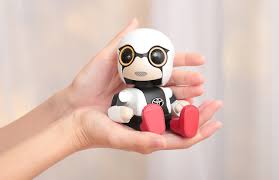
2-2-2:  Kirobo Mini Robot-Toyota [$689 JTrendShop]  “Toyota has teamed up Tomotaka Takahashi, the man behind the bestselling Robi and many other innovative robots, to create Kirobo Mini. This cute little robot is a miniature version of the Kirobo, Japan’s first robotic astronaut developed by Takahashi to accompany Koichi Wakata into space.

The palm-sized Kirobo Mini wobbles, gestures, blinks, speaks in a unique voice, and responds emotionally to you. Proving that robots can be both cute and useful, Kirobo Mini recognizes your voice and serves as your communication partner at home, work or in the car.”

YTube= https://youtu.be/G__ruOOlv-Q?t=1

Kirobo mini robot

Track 2 Branch 3: Zoomorphic Empathic forms:

2-3-1:  Paro Seal Therapeutic Robot (2003)[$5-6000, N/A JTrend Shop] [http://www.parorobots.com/].  Developed at the same time as the Yumel doll as part of the METI Ministry project, the Paro Seal Therapeutic Robot (2003) was designed to provide an alternative to traditional live-animal therapy.

“Modeled after a baby harp seal, the Paro Robot Seal Healing Pet is one of best things we have ever sold on JapanTrendShop, not least as it is such a high quality product but also because it is so well-intentioned. Paro is a seal that is designed not simply to be a cool robotic animal, but to actually communicate with people and make their lives better.

Now Paro is available in two new colors, pink and gray. As with the white and gold model, it can move its head in multiple directions, plus its front and rear flippers. Paro’s blinking eyes give off realistic emotional facial expressions and its sensors can recognize touch, light, temperature and posture. Just stroke Paro and you will experience a robotic pet more responsive than you ever imagined, perhaps as close as humanity has come yet to a robot conscious of itself and the people around it.”

YTube= https://youtu.be/oJq5PQZHU-I?t=2; https://youtu.be/PNw4oicWmWU?t=3

paro-robotic-healing-seal-1

2-3-2:  Joy For All Companion Cat/Dog [$100-120 Amazon].  “Hasbro has developed a new toy line, called Joy For All Companion Pets, for senior citizens in need of companionship who aren’t able to care for a real animal. These robotic cats look, feel, and act pretty much like the real thing—they don’t walk, but thanks to built-in sensors, they purr and nuzzle when touched; they also meow, sleep, and roll over for belly rubs. The companion pets are available in three varieties (orange tabby, silver with white mitts, and creamy white) and retail for $100.  There is also a dog version.”

YTube cat= https://youtu.be/NiyT9iXcBCo?t=3

joy-for-all-cat

YTube dog= https://youtu.be/tcfdI5MCja8?t=3


2-3-3:  Omnibot OHaNAS Robot Pet [$275 JTrendShop]  “Created by Takara Tomy as part of the Omnibot series of robots in partnership with Japanese phone carrier NTT DoCoMo, the OHaNAS is like a small sheep that speaks to you (the name means “talking”). It understands greetings and responds to friendly physical contact like stroking. It also chats to you about the weather, time of year, etc. It can be used as music player and also remembers user information. It connects to your phone via Bluetooth and can even go online to look up basic questions that you want to ask. The eyes also light up in a range of colors to let you know its mood!”

[YTube= https://youtu.be/WEoDfXcg1no?t=4]

omnibot-ohanas-robot-pet

2-3-4:  Hug-and-Dream Micky Mouse from TakaraTomy [$60 JTrendShop].  “TakaraTomy’s first Hug and Dream sleeping robot in a Minnie Mouse design was a big hit around the world, and now here is a follow-up – not surprisingly, it’s Mickey Mouse. This doll is designed by scientists to help with an infant’s breathing as he or she sleeps. Better respiration means better dreams and a better night’s rest.

Your child will hug Mickey, who “breathes” in rhythm with them, assisting them to calm down and get into a neurologically appropriate state for sleep. The world’s most famous mouse is the ideal companion to help guide your special one to an uninterpreted slumber that will help them recharge for the activities the next day will bring.”

hug-and-dream-mickey-mouse-sleeping-robot-1

2-3-5: Qoobo Robotic Cat Tail Pillow (2018)[$183 JTrendShop].  “Yukai Engineering Qoobo has to be one of the most unique additions to the pantheon of Japanese robotics we’ve ever seen. Stroke the “headless cat” pillow and feel its response to your touch, which mimics the natural behavior of a cat tail. The furry contact and interactive character of the Qoobo tail will soon make it an indispensable part of your domestic life. Joining the likes of the Paro and Yume Neko Dream Cat, the Qoobo is intended as a therapeutic pet-style robot to comfort and cheer you up.”

YTube= https://youtu.be/f2heW910o7c?t=2

qoobo-tail

2-3-6:  Hugvie Huggable Cushion Robotic Companion [$148 JTrendShop]  “Relieve stress and sleep better thanks to this “communication media” cushion from Japan, created by a special partnership of robot engineers, a futon vendor and a textile firm. Hugvie (a portmanteau of “hug” and the French word for life) is designed for young kids and grown-ups as a physical way to communicate. You place your phone or other device into the pocket in the head and then embrace it. The hug-pillow shape becomes an interactive communication media, helping to stimulate an emotional response so the user experiences another human presence even if they are alone.

Equipped with head, torso and limbs, the simple cushion is an ideal communication device for long-distance relationships! Kids could also be soothed by the sound of their mother’s voice before they sleep. Based on a robot originally developed by Professor Hiroshi Ishiguro’s Advanced Telecommunications Research Institute International (ATR), there are two versions in different sizes, one for kids and a regular size Hugvie for grown-ups. The cushion materials are also optimally designed to be more huggable.”

YTube= https://youtu.be/nJXkL7bcQR0?t=3

hugvie-huggable-robotic-toy-1


Track 2 Branch 4: Zoomorphic Pet Surrogates, not intentionally Empathic:

2-4-1:  Healing Partner Dacky [$N/A JTrendShop]–TakaraTomy’s Dog variant of Yumel/Nerul companions, (2005?).  New from Takara Tomy, Healing Partner Dacky is the latest in robotic pet communication. Dacky has SIX internal sensors through which he learns about you and develops a personality of his own. Stroking him on his head, back, or paw will elicit certain responses as you get to know him, and he responds with/to verbal communication as well.  Develops a vocabulary of over 650 words and can talk with you (Japanese of course); sings; by being touched, carried, and talked to he develops a personality and matures; adapts to your sleep cycle.

YTube= https://youtu.be/hUfJhLiD5zQ

healing-partner-dacky
2-4-2:  Aiken Shiba-chan Robotic Dog [$N/A JTrendShop]  “The Aiken Shiba-chan is a robotic version of Japan’s most famous dog, the shiba inu. He can interact with you through 85 different patterns of behavior. The design features 3 types of advanced sensors in 10 places, including the head, back, nose, and paws. The dog responds to sound, brightness, and touch. Vary the way you touch him to see how he responds, including wagging his tail. The robotic pet comes with its own collar and bone. Put the bone in his mouth to make him happy!”

Ytube= https://youtu.be/D8idBW5CDB8?t=4

aiken-shiba-chan2

2-4-3:  Himitsu no Kuma-chan Cuddly Bear Robotic Companion [$N/A JTrendShop].  “Himitsu no Kuma-chan (The Secret of Kuma-chan) is a cuddly toy that can communicate in real-time. Himitsu no Kuma-chan may look like an ordinary stuff toy but he’s so much more. Thanks to his unique integrated computer technology, he will respond naturally to greetings in Japanese like “Konnichiwa” and basic questions, making this not only a cute companion but a great way to learn Japanese too. Call him by his name, Kuma-chan, and he will answer!

Available in brown, white or pink, your new “secret” robotic friend will entertain and charm you as it chatters away in Japanese. It can also play word games like Shiritori. You’ll find Kuma-chan’s conversation and responses almost too life-like, you may forget he’s not an actual person!”

himitsu-no-kuma-chan-cuddly-bear

2-4-4:  Yume Inu Dream Dog Labrador Retriever [$N/A JTrendShop]  “Continuing Sega Toys’ popular series of robotic pets, the Yume Inu Dream Dog Labrador Retriever is perfect for all ages. Enjoy the canine companionship of a pet pooch without the fuss or hassle a real animal can bring. This adorable labrador reacts when spoken to and will also bark joyfully when stroked. He may even grow sleepy if you give him lots of attention, and he will certainly love it if you give him his squeezy bone toy — even opening his mouth to take it!

Just like a real animal, the white puppy will know when he’s being ignored and will ask for attention. While away the hours at home with your new pet. The cute behavior and responsiveness of the retriever may even have you forgetting that he’s only a toy!”

YTube= https://youtu.be/NdcejbiyK8A?t=6

yume-inu-dream-dog-puppy-labrador-retriever-robot-2

2-4-5:  KeiTai Wanko Interactive Puppy [$183 JTrendShop]  “TakaraTomy’s Keitai Wanko is a fun interactive dog toy for kids to play with. Just put the mobile phone (keitai) near this cute puppy (wanko) and hear him get excited! The pooch even has a biscuit which he will “eat” audibly when you give it to him.

The Wanko pet can make over 300 different sound effects, all produced by how you interact with him with the two props, meaning kids will never tire of the dog. Just like a real pet only without the hassle or mess! Choose between a pink puppy for girls or a brown poodle for boys.”

YTube= https://youtu.be/l5F0eiaoXek?t=2

keitai-wanko-dog-toy-phone-takara-tomy-1

2-4-6:  Sakadachi Lucky Robotic Puppy [$108 JTrendShop]  “You’ve never had a pet, or a toy, like this. The Sakadachi Lucky Puppy from Sega responds to 13 different voice commands – not only the basics like “come” and “lie down,” but also “sing” and “headstand.” The headstand is Sakadachi Lucky’s signature move, as sakadachi is the Japanese word for “headstand.” This clever toy dog can bark Twinkle Twinkle Little Star.  The Sakadachi Lucky Puppy is part of Sega’s sell-out line of toys that employ modern voice recognition and robotics without sacrificing the cute and cuddly factor. Case in point: Lucky comes with a fuzzy white coat with colorful circus star decorations, a bright pink leash, and hours of fun and wonder in store!”

YTube= https://youtu.be/Mm6Atu03Vp4?t=2

sakadachi-lucky-puppy-3

2-4-7:  Yume Neko Dream Cat Robotic Pet [$252 JTrendShop]  “The best selling Sega’s series of Yume Neko robotic pets continues with this new and improved version of the original feline. The Yume Neko Dream Cat is just like a real animal, interacting with you and able to sense when you are near. This pet makes sounds in response to your behavior and adores it when you use the included comb to stroke its fur. The Yume Neko Dream Cat opens and closes its mouth, blinks its eyes, and moves its ears. It is fitted with sensors in its head, cheeks, stomach, and back that can detect when it is touched. Just don’t grab its tail or it will get angry!”

YTube= https://youtu.be/OvTOaIigNj8?t=2

yume-neko-dream-cat-sega-2